-

Kazimir Malevich
-

title
The Russian Avant-Garde was a groundbreaking movement that flourished in the Russian Empire and Soviet Union. There were many art movemments that floursihed during this time including: Suprematism, Constructivism, Russian Futurism, Cubo-Futurism, Zaum, Imaginism, and Neo-primitivism. It is known for its bold experimentation and rejection of traditional artistic conventions. Artists like Kazimir Malevich were very influential during this time, greatly changing the way Western art is now as they broke free from representational art and embraced geometric, abstract forms.
This movement was at its peak particularly during Russian Revolution of 1917, where new ideas of avant-garde clashed with socialist realism.
Kazimir Malevich
title
The Bauhaus was a German art school founded in the city of Weimar by the German Architect Walter Gropius. It is known for its radical approach of unifying all the arts with principles of mass production and function. This Bauhaus became known as the avant-garde and international style which later became very influential in modern design, modernist architecture, and architectural education. The most important influence on the Bauhaus was modernism, a cultural movement with origns dating back to the 1880s.
The specific features of the Bauhaus forms and shapes include simple gemoetric shapes like rectangles and spheres, and the buildings, furniture, and fonts often had rounded corners and sometimes rounded walls.
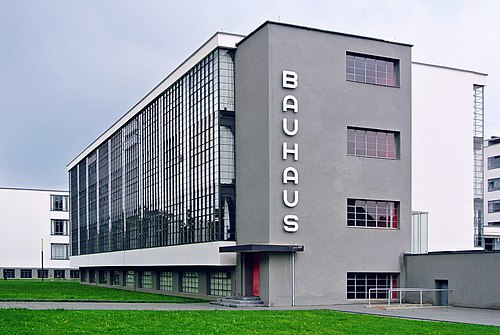
Bauhaus Building, Dessau, Germany

"Wassily" Armchair (1925)
Marcel Breuer